
If your paper is heading to a Science family journal, the figure rules arrive in two waves. The public Information for Authors covers what gets a submission delayed: up to 10 figures and tables combined, figures embedded at first mention with legends below, universal fonts such as Times New Roman, Supplementary Materials as a single PDF no larger than 25 MB, and — for Science Advances — no graphic representation of the abstract. The exact widths, resolutions and file formats arrive later, in the Science family Guide to Preparing Figures you are pointed to at revision. That ordering is the trap: by the time you read the millimetre and DPI numbers, your figures already exist. This checklist covers what AAAS states publicly as of October 2026, and how to build figures that survive the second wave without being redrawn.
Why the Science family's figure rules arrive in the wrong order
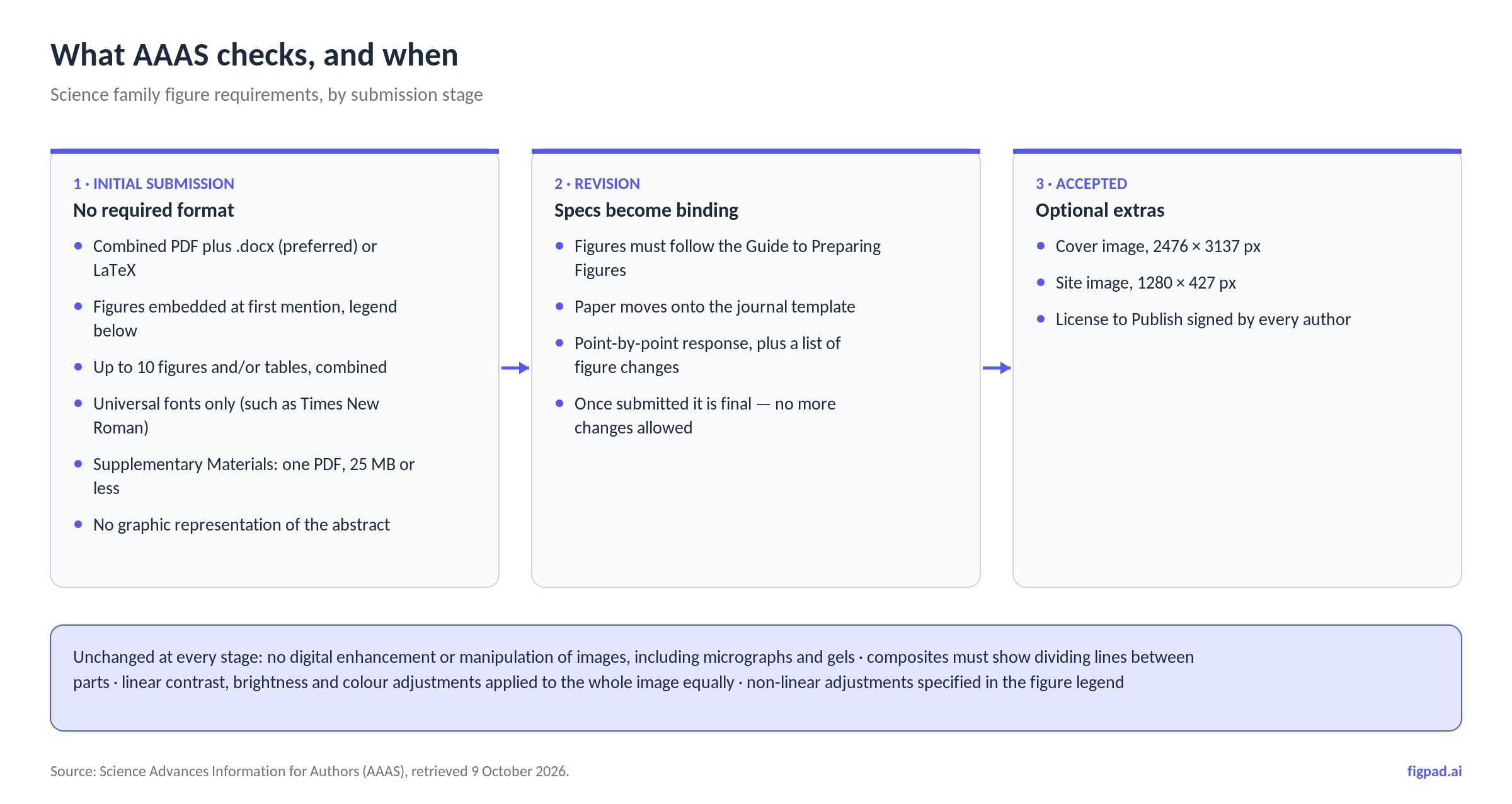
Every journal has figure specs. What makes AAAS distinctive is the sequencing. At initial submission the instructions are deliberately permissive: "There is no required format for initial submission." You upload a combined PDF plus a .docx (preferred) or LaTeX source, figures embedded at first mention with legends below. Nobody measures your panel labels or checks whether your PNG holds up at print width.
Then the paper is reviewed and the tone changes. Figures "should follow our Guide to Preparing Figures," the paper moves onto the journal template, and — the sentence worth pinning above your desk — "Once you submit the revised paper, it is considered final. No more changes are allowed."
So the specs bind at exactly the moment you have a reviewer response to write, a co-author in another time zone, and a figure set optimised for a Word document. If those figures are flat raster exports, every mismatch is a redraw: a font production won't render, labels illegible once the figure is reduced to one column, a panel that has to be relabelled because reviewer 2 wanted the conditions in a different order.
What AAAS binds you to at initial submission
Taking the Science Advances Information for Authors as the reference point (retrieved October 2026; the Science family shares one Guide to Preparing Figures, so confirm the page for your target journal), the publicly checkable requirements at first upload are:
- A combined ceiling of ten. Research articles allow up to 15,000 words, 10 figures and/or tables combined, and 80 references; reviews allow 10,000 words, the same 10 figures and tables, and up to 150 references. Figures and tables share one budget — four tables means six figures.
- Figures live in the manuscript, not a separate folder. They appear in the combined PDF and are embedded in the Word file with the legend below each one, numbered in order of citation.
- Universal fonts only. The instruction is explicit: "use universal fonts (such as Times New Roman) only, as special fonts may affect the rendering of your figure or table files." It is the most commonly ignored line in the document, and the one most likely to corrupt a figure silently in conversion.
- Table legends under 250 words, with no footnotes in column heads — put that detail in the legend instead.
- One Supplementary PDF, 25 MB or less, with supplementary figures numbered Fig. S1, S2 and so on. Auxiliary and movie files are limited to 10 files that together cannot exceed 25 MB.
- No graphical abstract. For Science Advances, "graphic representations of the abstract are not permitted." One made for another journal does not travel here, though it still earns its keep on a lab page or a conference slide.
- Video has its own rules. Clips should be .mp4 (.mov accepted with h.264), HD 1920 × 1080 where possible, and animated GIFs are not accepted.
What changes at revision — and why that gate is expensive
Two things happen at revision. The specs stop being advisory — your figures have to match the Guide to Preparing Figures, the PDF where widths, resolutions, formats and line weights live — and the submission becomes final.
So revision is the wrong moment to discover your figures are not editable. A reviewer asking you to split a panel, rename a condition or drop a non-significant comparison is routine. Answering should cost a text edit, not a weekend reconstructing a figure whose only source was a prompt you no longer have.
The defensive move is to decide, before the first submission, that every figure has a structured source: real text objects, separate shapes, named layers. Then whatever the Guide specifies — a width, a serif font, a vector format — is a settings change rather than a rebuild. The one format you cannot fix cheaply is a flattened bitmap, which is exactly what most AI image generators hand you.
The image-integrity rules that never relax
These apply at every stage and they are the ones that turn into correspondence with an editor rather than a formatting fix:
- Digital enhancements or manipulations of images, including micrographs and gels, are not allowed.
- Figures assembled from multiple photographs or images must indicate the separate parts with lines between them.
- Linear adjustment of contrast, brightness or colour must be applied to an entire image or plate, equally.
- Non-linear adjustments must be specified in the figure legend.
- Discovery of figure manipulation or enhancement "will require additional documentation from the authors and could be grounds for rejection."
The line this draws is one most authors already hold intuitively but should state explicitly in their own workflow: generated and drawn artwork belongs to schematics, mechanisms and conceptual diagrams, and never substitutes for a data image. A generated micrograph is not a micrograph. One further honest note, which FigPad's own pricing FAQ makes too: some journals ask authors to disclose AI-assisted figure creation, so check your target journal's policy and never present a generated image as primary experimental data.
Figure specs across three journals, as of October 2026
Nature and PLOS publish their numbers on an open page you can bookmark. AAAS publishes the binding numbers in a Guide to Preparing Figures PDF referenced from the revision instructions, so the only honest entry in the AAAS column is "open the Guide for your journal." The other two columns are quoted from the publishers' own author pages, checked on the date below.
| Spec | Science Advances (AAAS) | Nature | PLOS ONE |
|---|---|---|---|
| Where the binding numbers live | Guide to Preparing Figures (PDF), referenced from the revised-manuscript instructions | Public "Final submission" author page | Public figure-requirements author page |
| Preferred formats | In the Guide; initial submission has no required format | AI, PostScript, vector EPS or PDF; layered PSD or TIFF for photos; JPEG at 300–600 dpi accepted | TIFF or EPS only |
| Width | In the Guide | 89 mm single column, 120–136 mm column-and-a-half, 183 mm double column; 247 mm full page depth | 6.68 cm minimum to 19.05 cm maximum; max height 22.23 cm |
| Resolution | In the Guide | At least 300 dpi at final size for photographs | 300–600 dpi |
| Fonts | "Universal fonts (such as Times New Roman) only" | Sans-serif, preferably Helvetica or Arial; text 5–7 pt; panel labels 8 pt bold | Arial, Times or Symbol, 8–12 pt |
| Colour mode | In the Guide | RGB recommended, CMYK accepted | RGB (8 bit/channel) or grayscale |
| Line weights | In the Guide | 0.25–1 pt at final size | Not stated on the figures page |
| File size limits | Supplementary PDF ≤ 25 MB; auxiliary and movie files ≤ 10 files and ≤ 25 MB combined | Extended Data ≤ 10 MB per file, max 300 ppi, max 18 × 24 cm | 10 MB or less per figure |
Specs as of October 2026, taken from each publisher's own author pages. Specs may change; we re-check monthly.
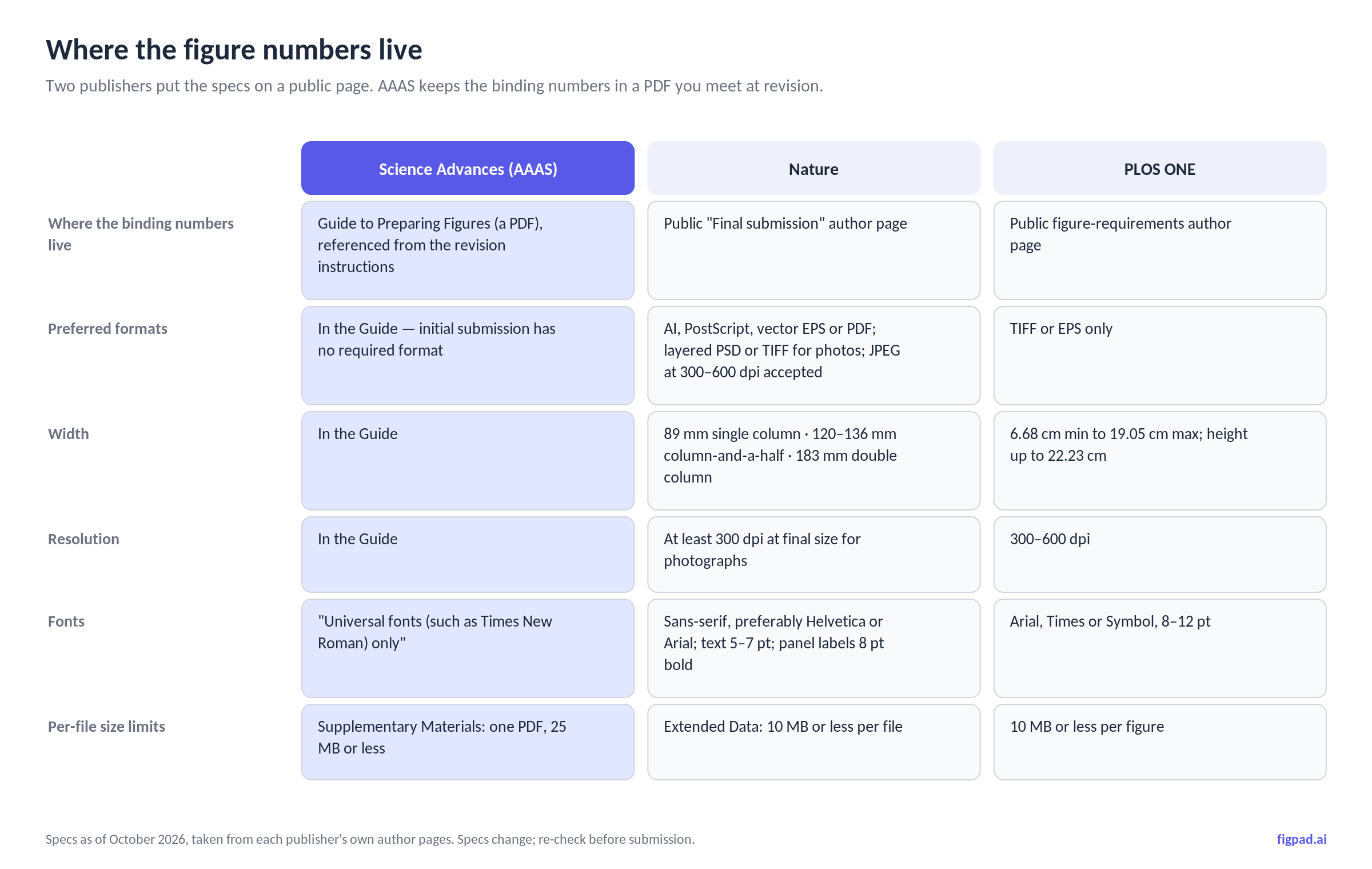
Look at the font row. Nature wants sans-serif at 5–7 pt, PLOS wants Arial, Times or Symbol at 8–12 pt, AAAS wants a universal font such as Times New Roman. Three journals, three typographic answers, one figure. If your text is text, that is three exports; if your text is pixels, that is three redraws — and Nature says it outright on the same page: do not convert text to outlines.
The 12-point check before you upload
- Figure and table count together is 10 or fewer.
- Each figure is cited in the text, numbered in citation order, and embedded at first mention with its legend below.
- Every piece of type in every figure is a real text object in your source file, not an outline or a bitmap.
- Fonts are universal — Times New Roman or an equally safe face — and the same throughout the figure set.
- The smallest label is still legible at the narrowest column width you might be assigned.
- Multi-panel composites show dividing lines between parts taken from different images.
- Any contrast, brightness or colour adjustment was applied to the whole image equally; anything non-linear is declared in the legend.
- No generated or enhanced image is standing in for primary data.
- Table legends are under 250 words, with no footnotes in column heads.
- Supplementary text, tables and figures are one PDF of 25 MB or less, figures numbered Fig. S1 onward.
- Movies are .mp4 (or .mov with h.264), ideally 1920 × 1080, and no animated GIFs.
- You have opened the Guide to Preparing Figures for your journal and confirmed width, resolution, format and line-weight specs against the version in front of you today.
Items 3 to 5 are the only ones that are hard to fix late. The rest is half an hour of housekeeping.
How FigPad fits
FigPad exists for item 3. Describe the figure, upload a sketch, or hand it a reference image, and you get a structured draft you can keep editing rather than a flattened picture. Exports are layered SVG, where text is still text and arrows are still arrows (on every plan, including free), editable PPTX where every element lands in the slide as a selectable object, and PNG or JPG at the resolution the model generates. When a reviewer asks you to change one label, you change one label — which maps directly onto the AAAS revision gate, where changes stop being allowed once you hit submit.
The pricing is built around revision rather than first drafts. One generation costs 2 credits, a text fix costs 2, editing elements on the canvas is free, and exporting an editable SVG costs 4 credits — re-exports of the same version are free, which matters when one journal wants serif and the next wants sans-serif. A typical generate–revise–export loop runs about 16 credits. Plans start at $12/month billed yearly; Plus is $20/month billed yearly or $29 month-to-month, Pro is $29/month billed yearly or $49 month-to-month, and one-time credit packs start at $12 for 95 credits that never expire (prices checked 2026-11-02). Figures on free and paid plans come with a perpetual authorization to publish them, with no per-figure fees and a free, verifiable Publication Authorization Certificate, and the Terms of Service state: "We do not use your Inputs or Output to train our own models."
Starting from a description or a hand sketch, the AI scientific figure generator is the entry point; assembling and relabelling panels for a submission set, the scientific figure creator is closer. Export formats and credit costs are on the pricing page, and every new account starts with free credits and no credit card — enough to generate a first figure and try the editing canvas.
When you should stay with Illustrator or a plotting library
Three cases, stated plainly.
Your figure is data. Scatter plots, survival curves, spectra, dose–response fits belong to whatever produced the numbers — matplotlib, ggplot2, Origin, GraphPad — and should be generated from the dataset so re-running the analysis re-renders the figure. Do not draw a plot; plot it.
You are doing final typographic surgery against a strict spec. Setting every label to 6 pt Helvetica, enforcing a 0.25 pt minimum stroke, converting a colour profile for print: Illustrator and Inkscape are built for that, and FigPad's layered SVG opens in both without a conversion step. Draft and revise structurally, then finish in a vector editor if the Guide demands something fussy.
Your lab's figures must match a long-standing visual system. If you have a BioRender library and a decade of papers that look alike, consistency can be worth more than speed on one figure. BioRender's vetted icon set and standardisation are real strengths, and switching mid-paper rarely pays.
Key Takeaways
- AAAS asks for almost nothing at initial submission — no required format — and almost everything at revision, which is also the point at which "no more changes are allowed."
- The binding numbers for width, resolution, format and line weight live in the Science family Guide to Preparing Figures PDF, not on the public instructions page, so open it before you rebuild anything.
- The publicly stated limits are worth checking today: 10 figures and tables combined, universal fonts such as Times New Roman, table legends under 250 words, one Supplementary PDF of 25 MB or less, and no graphical abstract for Science Advances.
- The integrity rules never relax — no enhancement or manipulation, dividing lines in composites, whole-image linear adjustments only, non-linear adjustments declared — and generated artwork belongs to schematics, never to data images.
- Editability is the only part of the checklist that is expensive to fix late. A figure whose text is still text survives a font rule, a column width and a reviewer's relabel; a flat bitmap survives none of them.
