

If you are looking for free scientific figure assets in 2026, five names come up repeatedly: SciDraw (scidraw.io), ScienceSlides, NIH BioArt Source, Servier Medical Art, and Bioicons. They are not equivalent. SciDraw is a community repository of CC BY drawings with Zenodo DOIs. NIH BioArt Source ships 2,000+ illustrator-made assets as AI, EPS, PNG and SVG with no account required. Servier Medical Art has roughly 3,000 CC BY 4.0 medical images — but downloads are PPTX and PNG only, not SVG. Bioicons holds 2,829 icons across at least six different licenses. ScienceSlides is not free at all; it starts at $99. This guide compares what each one actually gives you, what the license obliges you to do, and where an asset library stops being enough — usually the moment a reviewer asks you to change one label.
What a "free figure library" is, and what it is not
An asset library gives you pieces. It does not give you a figure. That distinction sounds pedantic until you are three days from a resubmission deadline.
Every library in this comparison hands you individual objects: a macrophage, a centrifuge, a liver, a receptor. You still have to open something else — Inkscape, Illustrator, PowerPoint, Keynote — and do the composition: scale each object so the mitochondrion is not larger than the cell, align the arrows, set a consistent type size, pick a palette that survives grayscale printing, and export at whatever the journal demands.
That assembly step is where the hours go, and it is the step nobody benchmarks. A free library saves you the drawing. It does not save you the layout, and it definitely does not save you the second layout you do after peer review.
SciDraw is free and citable — but check which site you landed on
SciDraw at scidraw.io is a repository of high-quality drawings of animals, experimental setups, and apparatus, contributed by working scientists. Content is released under Creative Commons Attribution (CC BY), and contributions carry Zenodo DOIs, so you can cite an individual drawing the way you would cite a dataset. Vector SVG is the primary format; some entries also offer PNG. No login is needed to download. Its strongest coverage is behavioral neuroscience and model-organism work — rodent behavior rigs, Drosophila anatomy, electrophysiology setups — exactly the material that general medical icon sets tend to skip.
Two practical cautions. First, coverage is uneven by design: it is a volunteer repository, so a niche your lab works in may have three drawings or thirty. Second, and more confusingly, there is a separate commercial AI product marketing itself under a near-identical name at sci-draw.com. It is a different organization with a different business model, and much of the "SciDraw comparison" content currently ranking on Google is published by that company about itself. If you searched for the free CC BY repository, make sure you are on scidraw.io.
ScienceSlides is not a free library
ScienceSlides, from VisiScience, keeps appearing on "free scientific figure resources" lists. It is not free. As of September 2026, VisiScience's published education/non-profit starting prices are $399 for the ScienceSlides Suite, $299 for ScienceSlides Standard, and $99 for ScienceSlides Online. Prices may change; we re-check monthly.
What you get for that is genuinely useful and genuinely dated. It is a PowerPoint add-in for Windows and macOS: objects are vector graphics, fully editable inside PowerPoint, most slides carry literature references with one-click PubMed lookup, and the license explicitly permits use in papers and with students. That is a real publication path — and it delivers editability inside PowerPoint, which most icon libraries do not.
The problem is currency. The packaging still reads "ScienceSlides 2014," and a one-time CD-or-download purchase model means the library your $299 buys is a snapshot. For a biomedical teaching lab that presents constantly in PowerPoint, it can still pay for itself. For a graduate student building figures for a 2026 submission, it is an odd first purchase.
The four libraries actually worth bookmarking
NIH BioArt Source
Run by NIAID, BioArt Source offers 2,000+ vectors, icons, brushes, swatches and templates, all made by professional medical illustrators working with subject-matter experts. Downloads include AI, EPS, PNG and SVG. No account is required. Per the site's FAQ, content is free for any use — educational, research, informational and commercial. Public-domain entries make citation appreciated but not required; entries under attribution licenses such as CC BY should be credited, ideally with the entry DOI. Contributions are closed, which is why quality is so even. This is the most under-used resource on this list.
Servier Medical Art (SMART)
Servier's library is the de facto standard in clinical and translational papers: about 3,000 anatomical and medical images under CC BY 4.0, usable commercially, adaptable, no permission letter needed. But read the format line carefully. Servier's own FAQ states that SMART images are not available in SVG — you download PPTX or PNG. The PPTX route means the objects arrive in PowerPoint as editable shapes, which is better than a flat PNG, but it also means Servier is a PowerPoint-first workflow whether or not you wanted one. The library is updated once a year.
Bioicons
2,829 icons as of September 2026, spread across 30-plus categories from amino acids and cell membranes to lab apparatus, safety symbols and neuroscience. Everything is SVG and everything downloads on click. The catch is licensing: Bioicons aggregates CC0, CC BY 3.0/4.0, CC BY-SA 3.0/4.0, MIT and BSD assets, and the site's own filter exists precisely because they are not interchangeable. CC0 needs nothing. CC BY needs a credit line. CC BY-SA is share-alike — a condition you should think about before mixing it into a figure destined for a copyrighted journal article.
Reactome Icon Library
Reactome's icons are the most standardized set here, and that is the point. They exist to build Reactome's Enhanced High Level Diagrams, so they follow a published spec: 200×200 px, RGB, Arial Bold 12pt, uppercase labels, proteins as rounded rectangles with 10 px corners, simple chemicals as octagons. Every element ships in SVG, EMF and PNG (PNG at 300 DPI, transparent background), under CC BY 4.0. Seven categories: cell elements, cell types, compounds, human tissue, ion channels, proteins, receptors. If you are drawing signaling pathways and want visual consistency without inventing your own conventions, start here.
The 2026 comparison table
| Library | Cost | License | Download formats | Best for | Watch out for |
|---|---|---|---|---|---|
| SciDraw (scidraw.io) | Free | CC BY, per-item Zenodo DOI | SVG (some PNG) | Behavior rigs, model organisms, apparatus | Uneven coverage; name collision with a commercial site |
| ScienceSlides | $99 (Online) / $299 (Standard) / $399 (Suite) | Commercial license; publication permitted | PPT / PPTX objects | Biomedical teaching in PowerPoint | Not free; packaging still branded 2014 |
| NIH BioArt Source | Free | Free for any use incl. commercial; some entries need attribution | AI, EPS, PNG, SVG | Trustworthy, illustrator-grade biomedical assets | No open contributions, so gaps stay gaps |
| Servier Medical Art | Free | CC BY 4.0 | PPTX, PNG | Clinical and anatomical figures | No SVG; updated once a year |
| Bioicons | Free | Mixed: CC0, CC BY, CC BY-SA, MIT, BSD | SVG | Molecular, micro, lab equipment | Per-icon license tracking; CC BY-SA share-alike |
| Reactome Icon Library | Free | CC BY 4.0 | SVG, EMF, PNG (300 DPI) | Pathway and signaling diagrams | Deliberately narrow visual style |
| BioRender (paid reference point) | $35/mo academic billed annually, $39 month-to-month; free tier exists | Publication rights on paid plans only | High-res export on paid plans | Breadth and standardization | Free tier: 3 figures, no publication or commercial use |
All figures verified as of September 2026 against each vendor's own site. Prices may change; we re-check monthly.
The license bookkeeping nobody warns you about
Here is the failure mode that catches people at the proof stage. You assemble one figure from four libraries. Two icons are CC0. Three are CC BY 4.0 from Servier. One is CC BY-SA 4.0 from Bioicons. One is a DOI-carrying SciDraw drawing. By the time your figure legend is written, you owe: a Servier attribution line with a link to the license, a modification statement if you recolored anything, a separate attribution for the Bioicons asset plus a share-alike judgment call, and a citation for the SciDraw DOI.
None of that is hard. All of it is easy to forget six months later when the copyeditor asks. Two habits fix it permanently:
- Keep a plain-text
figure-credits.txtnext to each figure file, one line per asset: source, URL, license, whether you modified it. - Prefer CC0 and CC BY over CC BY-SA when a share-alike obligation would be awkward, and write down why you made the substitution.
Free is a price, not an absence of terms.
The real bottleneck is the second draft, not the first
Reviewer 2 asks you to relabel "Treg" as "CD4⁺ Foxp3⁺ Treg" in all five panels and swap the arrow direction in panel C.
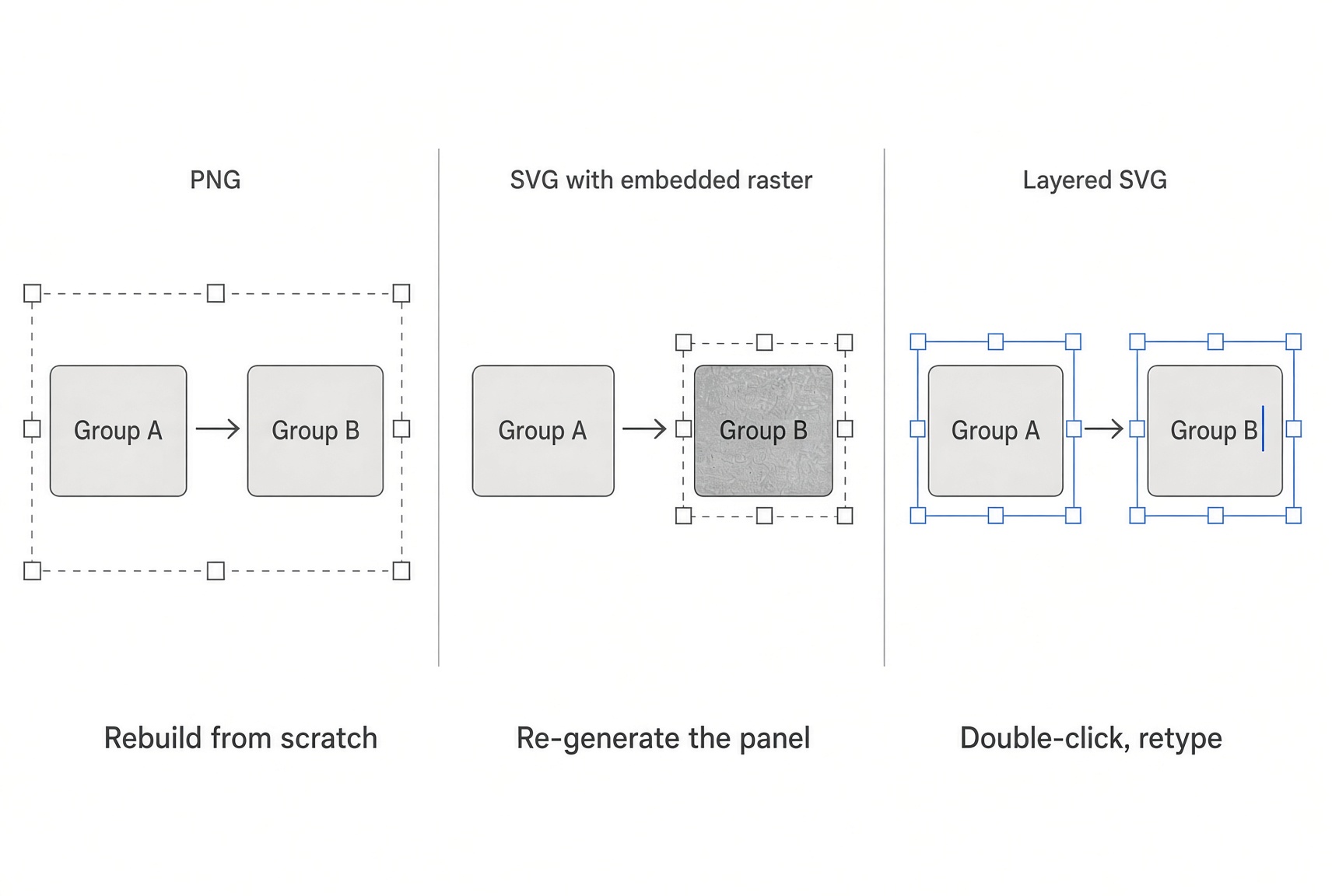
If your figure lives as a layered vector file with text as text, that is a five-minute edit. If you assembled it in a raster tool, or exported a flattened PNG and deleted the working file, or built it from a tool that welds everything into one outlined group, you are rebuilding. The free-library workflow is especially exposed here, because the assets came from four places and the only thing holding them together is whatever you did in Inkscape at 1 a.m.
This is why "does it export SVG" is the wrong question. The right question is: does it export SVG in which each label is still a separate, selectable text object? An SVG that traced your image into one welded mass of splines technically satisfies the file extension and helps you not at all.
How FigPad fits
FigPad is not an icon library and is not trying to replace one. It solves the assembly-and-revision half of the problem the libraries leave open.
You start from a prompt, a whiteboard sketch, or a reference image, and get a structured scientific figure you can edit on a canvas — then export it as layered SVG (text stays text, arrows stay arrows, shapes stay separate objects, available on Plus and Pro) or PPTX, where the graphic lands in your slide as editable objects rather than a pasted picture. High-resolution PNG is available at 2K on Starter, 4K on Plus, and 8K on Pro. There is also a vectorizer, which is the practical bridge for free-library work: if you have an existing bitmap asset with no vector source, you can convert it into an editable vector instead of redrawing it. Details on the AI scientific figure generator and scientific figure creator pages.
On cost structure, FigPad is public about the arithmetic. As of September 2026, one generation costs 2 credits, a text fix costs 2 credits, editing elements on the canvas is free, and exporting an editable SVG costs 4 credits, with re-exports of the same version free — so a typical generate → revise → export loop runs about 16 credits. Plans are $9–31/month billed annually ($19–39 month-to-month), and all paid tiers include publication rights, with no separate "publishing" tier and no per-figure charge. The pricing page has the current tier breakdown, and the BioRender alternative page walks through the comparison in more detail.
One honest caveat, and it is FigPad's own: some journals ask authors to disclose AI-assisted figure creation. Check your target journal's policy, and never present a generated illustration as raw experimental data.
When you should stay with the free libraries
Do not switch for the sake of switching. Stay with free asset libraries when:
- Your figures are icon-assembly problems, not drawing problems. If your panel is six standard cell types and four arrows, Servier or Reactome plus twenty minutes in Inkscape is genuinely the right tool.
- You need a specific, unusual, accurate object. A CC BY SciDraw drawing of a particular behavioral apparatus, or an NIH BioArt virion vetted by a subject-matter expert, is more trustworthy than anything generated.
- Your budget is zero and must stay zero. These libraries are free forever and permit publication. That is not a trial; it is the actual license.
- You need visual consistency with an existing standard. If your lab's previous six papers used Reactome conventions, keep using them.
- You already have an Inkscape or Illustrator workflow that works. A working pipeline you know beats a faster one you have to learn mid-deadline.
The honest framing: free libraries and generation tools are complements. Most efficient workflows we see use both — vetted library assets for standardized objects, generation for the custom scaffolding, and a layered vector file as the single source of truth for revisions.
Key Takeaways
- ScienceSlides is not free. Education/non-profit starting prices are $99 (Online), $299 (Standard), $399 (Suite) as of September 2026, and the product is still packaged as a 2014 release.
- Servier Medical Art has no SVG. CC BY 4.0 and excellent, but downloads are PPTX and PNG only, updated once a year — plan a PowerPoint-centric workflow around it.
- NIH BioArt Source is the most underrated free option: 2,000+ illustrator-made assets in AI, EPS, PNG and SVG, no account, free for commercial use.
- "Free" still carries obligations. Bioicons alone spans CC0, CC BY, CC BY-SA, MIT and BSD. Keep a per-figure credits file from day one.
- Asset libraries solve the first draft; revision cost is decided by file structure. Insist on layered vectors where every label is a separate text object, or budget for a rebuild each review round.
